
 Malay
 English
 Russian
 Thai
 Korean
 Chinese
 Japanese
 Vietnamese
 Tamil
 Turkish
 Arabic
 Portuguese
 Indonesian
 French
 Spanish
pengenalan
An ABS plastic shredder plays a critical role in recycling acrylonitrile-butadiene-styrene (ABS) plastic, a material widely used in industries such as automotive, electronics, home appliances, and toys due to its outstanding mechanical properties and processability. This widespread application generates substantial production scrap and end-of-life products, making ABS recycling and regeneration critically important. Shredding, as the initial and critical stage of the recycling process, directly determines the efficiency and quality of subsequent cleaning, sorting, and regranulation.

The core objectives of ABS shredding include:
- Shredding irregularly shaped, bulky waste ABS products (such as automotive bumpers and appliance casings)—or scrap generated during manufacturing—into relatively uniform small pieces or granules.
- Increasing material density to facilitate easier handling and processing, thereby reducing logistics costs.
- Generating granular material to prepare it for subsequent processes, such as washing, color sorting, and melt extrusion granulation.
- Separating impurities adhering to the ABS material.
ABS Plastic Shredders: Product Recommendations
Shengzhong, as a professional shredder manufacturer, supplies a full range of equipment including dual-shaft shredders, four-shaft shredders, small shredders, single-shaft shredders, and plastic crushers to meet different plastic recycling and size-reduction needs.
Double-Shaft Shredder

The double-shaft shredder features two synchronously counter-rotating shafts equipped with specially shaped cutting discs. Materials entering the crushing chamber are hooked by the discs and drawn between the shafts, where they are shredded through tearing, shearing, and compression actions. Typically without a screen, the output size is determined by the disc thickness and tooth count.
Double-shaft shredders are highly suitable for processing bulky, mixed, or metal-contaminated ABS waste, such as:
- Dashboards, bumpers, and door panels from dismantled end-of-life vehicles.
- ABS casings from discarded home appliances and electronic products.
- ABS waste containing metal screws or embedded metal components.
Four-Shaft Shredder

Four shaft shredder machine features four cutting shafts—typically two upper primary cutting shafts and two lower secondary shredding shafts. Material undergoes coarse shredding by the primary shafts, followed by fine shredding and shaping by the secondary shafts, before discharge through a screen.
The four-shaft shredder uniformly reduces large ABS waste into small, consistent pieces in a single pass, making it suitable for applications with strict output size requirements.
Single-Shaft Shredder
Comprising a rotating blade roller covered in cutting blades, a hydraulic pusher, and a screen, this shredder feeds material into a hopper. The hydraulic pusher smoothly directs material toward the rotating blade roller, where blades and stationary cutters generate intense shear force to shred the material. The screen aperture determines the final output size.
Compared to double-shaft and four-shaft shredders, the single-shaft shredder is more suitable for processing lightweight, thin materials.
Pencincang Aci Berganda Kecil
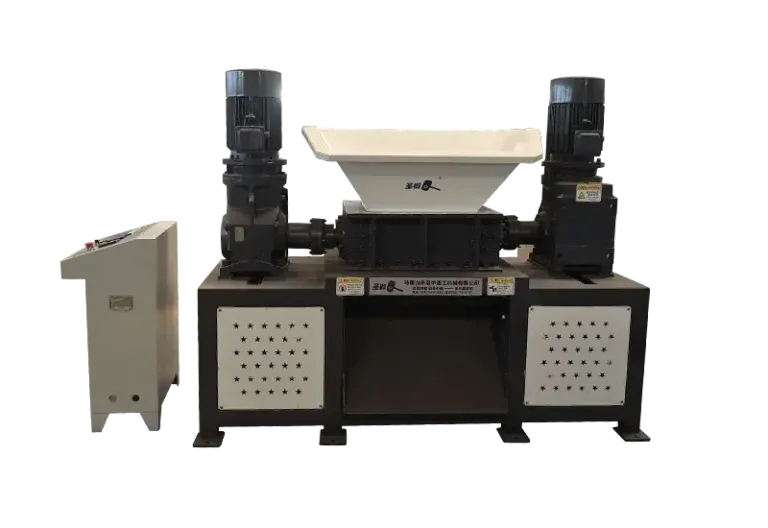
The small double-shaft shredder features a compact size and is designed for processing smaller-sized ABS waste.
Unlike low-speed, high-torque double shaft shredders, crushers feature high rotational speeds. Their blades are arranged in “V,” claw, or flat configurations, pulverizing materials through high-speed shearing action between moving and stationary blades.
High-speed crushers excel at processing clean, small-sized ABS sprues, rejects, or pre-shredded material. Their objective is to produce uniform, fine particles (commonly termed “crushed material” or “recycled material”) suitable for injection molding.
Parameters and Performance of ABS Plastic Shredders
The combined parameters of an ABS plastic shredder determine its processing capacity, efficiency, energy consumption, and the quality of the final product.
Motor Power
Motor power, measured in kilowatts (kW) or horsepower (HP), is crucial for ABS—a highly resilient material. Sufficient power ensures the blades can continuously and stably shear material without jamming or shutdowns.
Industrial ABS plastic shredders on the market span a wide power range. Small units may only have a few kilowatts, such as 3 hp (2.2 kW) to 30 hp (22.3 kW), while large production line ABS plastic shredders can reach up to 110 kW or higher.
Kapasiti Throughput
Throughput capacity, typically measured in kilograms per hour (kg/h) or tons per hour (t/h), indicates the weight of material the equipment can process per unit time under specific conditions.
The rated throughput capacity provided by manufacturers is a theoretical value. Actual throughput is significantly influenced by multiple factors, such as material properties, screen mesh size, and blade condition. Depending on the equipment model and application, throughput capacity can range from several hundred kilograms per hour (e.g., 300 kg/h, 650 lbs/hr) to several tons per hour (e.g., up to 4500 kg/h or even 5000 kg/hr).
Screen Size & Output Particle Size
The screen is the key component controlling the final product size, with its aperture directly determining the maximum size of the crushed ABS particles. Screen apertures typically range from 15 mm to 60 mm, or even larger. Some fine crushing applications may require smaller apertures.
If secondary crushing follows, a primary shredder can use a larger aperture screen (e.g., 50-60 mm) to achieve high processing capacity.
For materials intended for direct washing and pelletizing, smaller apertures (e.g., 20-40mm) are generally chosen to achieve more uniform particles, facilitating subsequent processing.
Some manufacturers, such as Shengzhong, offer customizable screens, allowing users to flexibly adjust output particle size according to specific production requirements.
Kelajuan pemutar
Rotational speed (RPM) is a key parameter distinguishing shredder types, significantly influencing crushing mechanisms, energy consumption, and equipment wear.
Low-Speed Shredders:Single-shaft, twin-shaft, and four-shaft shredders fall under low-speed equipment, typically operating between 17 RPM and 83 RPM.
These shredders generate extremely high torque to “gnaw” through hard materials; they operate smoothly with minimal noise and dust generation, slower blade wear, and moderately better tolerance for metallic contaminants.
High-Speed Shredders:Typically operate at 300-600 RPM or higher.
This type utilizes impact and rapid shearing forces for high production efficiency and superior particle shape. However, it has relatively lower torque, making it unsuitable for large feedstock; higher noise and dust levels; rapid blade wear; and sensitivity to contaminants.
Blade Material & Design
Blade performance directly impacts equipment lifespan, maintenance costs, and crushing efficiency. Common materials include:
High-grade Alloy Tool Steel:Such as D2, Cr12MoV, SKD-11, etc. Precision heat-treated for high hardness, wear resistance, and good toughness—standard configuration.
Carbide/Tungsten Steel Inlays:Carbide inserts embedded at critical cutting edges significantly enhance wear resistance and extend service life, particularly suited for processing glass-fiber-reinforced ABS or materials with high impurity content.

Drive System
The drive system transmits motor power to the blade shaft, with its design impacting torque output, overload protection, and equipment reliability.
Gear reducer drives are the most common configuration. They utilize high-reduction-ratio gearboxes (e.g., 29:1, 43:1) to convert the motor’s high speed into low-speed, high-torque output at the cutter shaft. This structure is proven and reliable. Other drive systems include hydraulic drives and direct drives.
Quick Guide to Choosing an ABS Plastic Shredder
1. Analyze Your ABS Material
Identify the source, size, and purity of the material.
Industrial scrap: Injection runners and sprues can be processed with a high-speed crusher, while large extrusion lumps usually require a double-shaft shredder or four shaft shredder.
Post-consumer waste: Large automotive parts are better handled by dual-shaft shredders, while thin electronic housings can use single- or dual-shaft machines.
Impurities: If metal or mixed plastics are present, choose a low-speed shredder and consider adding magnetic separation.
2. Define Processing Requirements
kapasiti: Select equipment based on required throughput and keep 20–30% capacity reserve.
Output size:
- 15–40 mm particles for washing and pelletizing
- Coarse shredding for volume reduction
- Fine particles for direct reuse of clean sprues
3. Evaluate the Machine
Focus on motor power, blade durability, machine structure, and safety systems such as overload protection and automatic reverse.
4. Consider Operating Costs
Check maintenance convenience, spare parts supply, energy consumption, noise, dust control, and supplier support to ensure reliable long-term operation.


