
 Korean
 English
 Russian
 Thai
 Chinese
 Japanese
 Vietnamese
 Malay
 Tamil
 Turkish
 Arabic
 Portuguese
 Indonesian
 French
 Spanish
The global shift toward sustainable packaging and manufacturing has led to a massive surge in Polylactic Acid (PLA) usage. While PLA is biodegradable under industrial composting conditions, its growing volume demands robust mechanical recycling. However, processing bioplastics introduces distinct mechanical and thermal challenges that standard recycling equipment cannot handle.
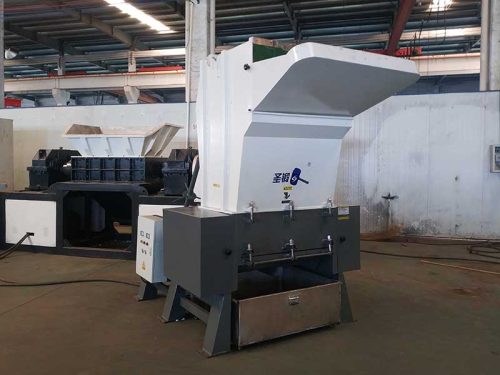
To achieve efficient, high-yield bioplastic recycling, using a dedicated PLA shredder is an absolute necessity.
1. PLA Material Properties and Shredding Challenges
PLA possesses distinct physical characteristics compared to traditional petroleum-based polymers like PET, PP, or HDPE. Managing these properties during mechanical size reduction dictates the success of the recycling process.
Low Melting Point and Thermal Sensitivity
PLA has a relatively low glass transition temperature (55℃ to 60℃) and a melting point around 150℃ to 160℃. Traditional high-speed granulators rely on high-velocity impact, which generates intense friction. This frictional heat quickly elevates the internal chamber temperature beyond PLA’s softening threshold.
Material Degradation and Equipment Damage
When PLA heats up inside an improper shredding chamber, it becomes sticky and viscous. This causes severe operational complications:
- Blade Smearing: Softened plastic wraps around cutting discs and welds onto the blades.
- Screen Clogging: Molten material blinds the discharge screen, completely blocking material flow.
- Thermal Degradation: The trapped bioplastic undergoes secondary thermal degradation, destroying its molecular weight and rendering it useless for high-quality downstream extrusion or pelletizing.
- Mechanical Overload: Clogged chambers cause bearing overheating, drive strain, and sudden equipment downtime.
2. What is a PLA Shredder?
A PLA shredder is an industrial size-reduction machine specifically engineered to process bioplastics without causing thermal degradation. Instead of high-speed impact, these machines utilize high-torque, low-speed shearing mechanisms to slice through materials cleanly, keeping frictional heat to an absolute minimum.
Core Applications
Industrial PLA shredders handle diverse waste formats across the manufacturing and consumer lifecycle:
- 3D Printing Waste: Failed prints, support structures, and empty filament spools.
- Thermoformed Packaging: Trimmings, skeleton scrap, and defective batches of PLA cups, trays, and clamshells.
- Industrial Films: Agricultural mulch films, stretch wraps, and flexible PLA food packaging.
- Baled Post-Consumer Waste: Bulky collection scrap requiring primary downsizing.


3. Key Features to Look For in a PLA Shredder
To achieve reliable, continuous bioplastic processing, a professional PLA shredder must incorporate specific engineering features:
Low-Speed, High-Torque Shearing
The machine must operate at low rotational speeds (typically between 20 to 80 RPM). High torque ensures the cutters shear tough or bulky PLA items effortlessly, while the low RPM minimizes friction and prevents the material from reaching its softening point.
Specialized Rotor Design and Thermal Management
Look for staggered, precise cutter geometries that reduce material friction. For high-volume or continuous industrial operations, integrated cooling mechanisms (such as water-cooled rotor shafts or forced-air ventilation) keep processing chamber temperatures safely below 50℃.
Adjustable and Precise Discharge Screens
To feed downstream pelletizing or twin-screw extrusion lines directly, the shredder needs adjustable, heavy-duty screens. These guarantee consistent, uniform output sizes without retaining material in the cutting zone for too long.
4. Shengzhong Heavy Industry Machinery: PLA Shredder Solutions
As a leading technical innovator in recycling machinery manufacturing, Shengzhong Heavy Industry Machinery designs targeted size-reduction systems optimized for bioplastic architectures. Depending on your production scale and waste format, we provide five specialized configurations:
Designed for high durability and robust throughput. A hydraulic pusher forces bulky PLA scrap against the rotating knife roller to interact with the fixed blades.
- Best For: Dense PLA purges, thick filament spools, bundled manufacturing scrap, and mixed plastic streams.
- Key Benefit: Features hardened steel knives arranged in a staggered pattern with adjustable discharge screens for precise particle control.

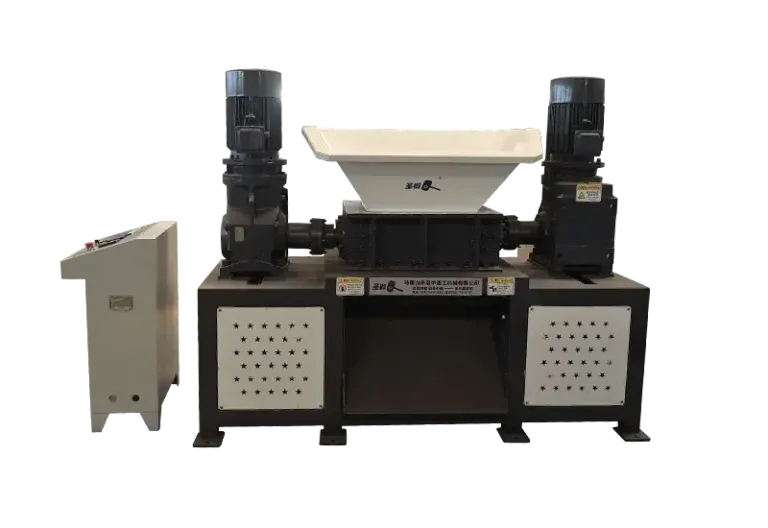
Utilizes dual counter-rotating shafts controlled by an intelligent PLC system. If the machine encounters an overload, the rotors automatically reverse to prevent jams.

- Best For: Bulky, hollow, or tangled PLA waste like large containers, structural packaging, and baled materials.
- Key Benefit: The high-efficiency tensile and shear stresses break down large profiles with minimal energy consumption and zero dust generation.
Engineered for high-performance, multi-stage size reduction. The four interlocking shafts create a highly efficient, scissor-like cutting action from multiple angles.
- Best For: High-volume industrial operations processing bulky plastics, pallets, and large-scale commercial bioplastic streams.
- Key Benefit: Gravity-fed, self-feeding design that eliminates hydraulic rams, achieving exceptionally fine, uniform outputs under 100 mm in a single pass.

A high-efficiency size-reduction machine equipped with wear-resistant High-Speed Steel (HSS) or tungsten blades.

- Best For: Thin-walled PLA scrap, thermoforming trim, injection-molding sprues, and clean, uniform manufacturing rejects.
- Key Benefit: Ideal for immediate, closed-loop recycling alongside injection or blow-molding lines where material can be instantly reground and re-fed.
A compact, low-noise dual-shaft system designed for localized or small-scale recycling environments.
- Best For: R&D laboratories, 3D printing hubs, small businesses, and localized industrial workshops generating lower volumes of PLA scrap.
- Key Benefit: Delivers industrial-grade PLC-controlled overload protection and precise, dust-free shredding within a space-saving footprint.
5. Conclusion
Efficient PLA recycling requires equipment tailored to its unique thermal sensibilities. A low-speed, high-torque PLA shredder ensures clean cuts, consistent particle sizing, and zero thermal degradation.
Whether you are processing precise 3D printing scrap or managing high-throughput industrial packaging waste, Shengzhong Heavy Industry Machinery provides engineered solutions to optimize your bioplastic recovery pipeline. Contact our technical team today to select the ideal shredding system for your operation.


