
 French
 English
 Russian
 Thai
 Korean
 Chinese
 Japanese
 Vietnamese
 Malay
 Tamil
 Turkish
 Arabic
 Portuguese
 Indonesian
 Spanish
This article will provide a comprehensive and easy-to-understand guide on the working principles of industrial shredder machines, covering key components, and processes of twin shaft shredder, broyeur à quatre arbres, broyeur à arbre unique.
How do industrial shredder machines function?
Cutting with industrial shredder machines
Industrial shredders have rotating blades mounted on a shaft. These cutting blades are positioned close to the fixed blades. As the material passes through the cutting chamber, the rotating blades create a shearing action that cleanly cuts through materials such as paper, cardboard, and soft plastics. The precision of this cutting action is critical to achieving uniform dimensions in the material.
Tearing wirh industrial shredder machines
The blades on parallel axes of industrial shredder machines interact to effectively tear materials such as rubber and textiles that are often elastic or fibrous in nature.
In cases where the material is elastic or fibrous, such as rubber or textiles, industrial shredders utilize the interaction of blades mounted on parallel axes to achieve the tearing effect. This tearing action effectively breaks down the elastic material into smaller, more manageable pieces. The design of the shredding structure ensures that shredder machines can handle a variety of materials with varying degrees of flexibility.
Fracturing with industrial shredder machines
Industrial shredder machines can handle materials that require more forceful methods, such as glass, electronic components or metal, by breaking the material. The cutting blade rotating at high speed impacts the material with huge force to break the brittle material into smaller pieces. This capability makes industrial shredder machines versatile tools for handling a variety of materials, including those that are traditionally difficult to break down.
Extruding with industrial shredder machines
Industrial shredder machines use the rotation of the shaft and the rotating cutting blade on the shaft to roll in and squeeze the material. This squeezing effect compacts materials such as metal cans, reducing their volume and making them more suitable for further processing. The controlled compression achieved at this stage helps improve the overall efficiency of the crushing operation.
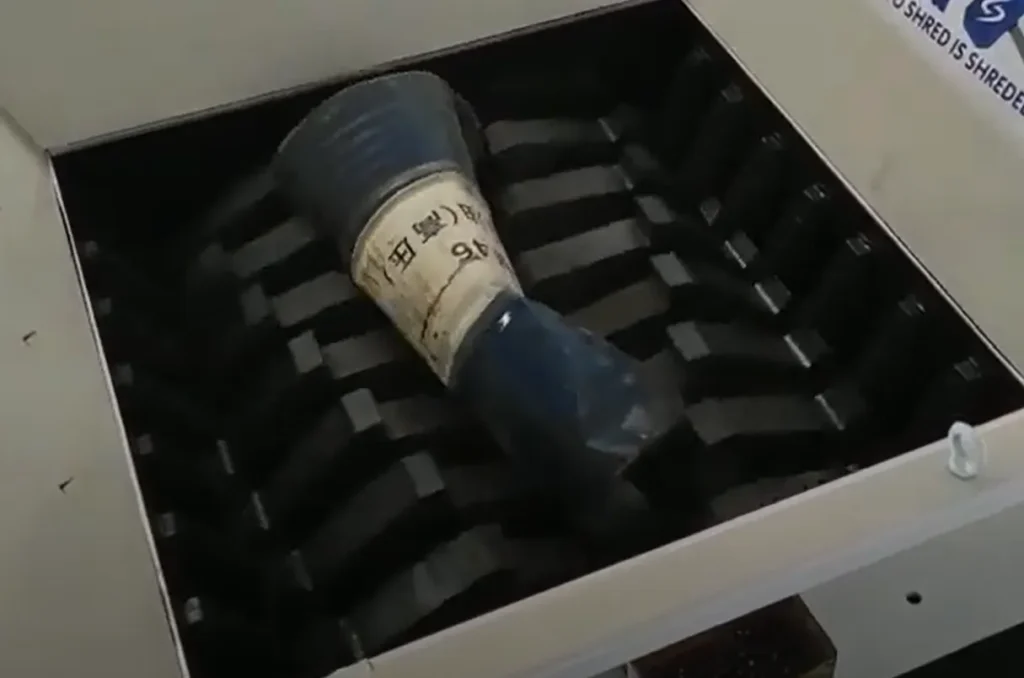
Main components of industrial shredder machines
Cutting Blades and Discs
Industrial shredder machines feature cutting blades designed for specific shredding purposes.
In the case of multi-shaft shredders, including double and four shaft variants, the cutting blades are characterized by rotating structures with teeth configurations. Crafted from high-quality alloys, these blades exhibit durability and resilience, enabling them to effectively process challenging materials such as glass and metal waste.

Single-shaft shredders, on the other hand, incorporate both fixed blades in the cutting chamber and movable blades or discs attached to a single rotating shaft. The synergy between fixed and movable elements is pivotal for the shredding function.


Shaft and Cutting Chamber
At the core of industrial shredders lies the shaft, a critical component responsible for driving the rotation of cutting blades. The installation point for these blades, the shaft’s efficiency determines the overall effectiveness of the shredder.
The cutting chamber houses the rotating shaft with cutting blades and the materials slated for processing. This chamber can be customized in size to accommodate a diverse range of materials, and manufacturers can tailor its dimensions based on specific processing requirements.


Screen
Screen refines shredded materials, ensuring consistent particle sizes. Depending on the material output requirements, different screen sizes can be customized to control the final size of the shredded particles. This adaptability allows the shredder to cater to various industries and applications with distinct particle size needs.
Control System and Operational Management
Control system enables real-time monitoring of the shredder’s performance by providing data on motor load, temperature, and other crucial parameters. Operators can utilize the control system to make adjustments, fine-tuning operating parameters, and even controlling the direction of shaft rotation for optimized shredding results.
Additionally, the control system manages ancillary equipment like conveyors, magnetic separators, crushers, and more, systematically enhancing overall work efficiency. Some advanced control systems include automatic features like reversal functions to prevent overloading due to oversized materials and automatic lubrication systems for ensuring smooth and continuous operation.

Caractéristiques de sécurité
Industrial shredders are equipped with an array of safety features, including emergency stop buttons, safety interlocks, overload protection, and safety guards. These features collectively safeguard operators during the machine’s operation, preventing unauthorized access to the crushing chamber and minimizing the risk of accidents. Automatic safety functions, such as emergency reversals to handle oversized materials, contribute to a secure and controlled operational environment.
What is the working principle of industrial shredder machines?
Four-Shaft Shredder Working Principle
The fundamental principle of a Four-Shaft Shredder involves the interaction of four rotating shafts equipped with sharp blades. These shafts are positioned in pairs in parallel, working together to efficiently shred various materials and reduce them into smaller pieces.

Feeding Process Initiation
The upper two parallel shafts play a crucial role in initiating the feeding process. Blades on these shafts create friction with the incoming material, aiding in its entry into the shredder.

Material Shredding
Upon entering the shredder, all four rotating axes come into synchronized action, each equipped with sharp, interlocking blades. This orchestrated movement creates a scissor-like cutting action that effectively tears and shreds materials from multiple angles, breaking them into consistent and uniform particle sizes.

Dual-Shaft Shredder Working Principle
A Dual-Shaft Shredder operates on the principle of two toothed rotating blades on separate shafts. The PLC (Programmable Logic Controller) controls the movement of these rotors, allowing them to move slowly in opposite directions for crushing the material.
Material Shredding Process
The material to be shredded is fed into the toothed rotating blades on the two shafts.
The PLC control enables the rotors to move slowly in opposite directions, ensuring effective crushing.
Overload Handling
In cases of overloading or the presence of foreign matter, the rotor can run in reverse to restore overload behavior and maintain operational integrity.
Single-Shaft Shredder Working Principle
A Single-Shaft Shredder initiates its operation by introducing material into a rotating cutting rotor, complete with sharp blades.
Material Processing
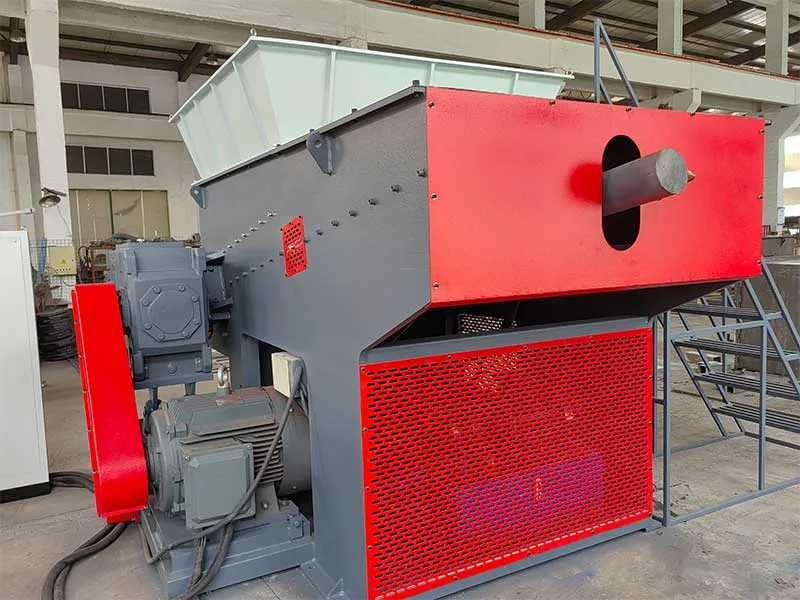
Material Processing
The rotating cutting rotor engages in shearing, tearing, and crushing the material as it undergoes rotation. Fixed reverse blades strategically enhance the shredding process.
Sieve and Particle Size Regulation
Shredded material drops to a sieve under neutral force, where it undergoes pulverization twice.
The size of the sieve holes determines the final particle size of the shredded material.
Control Adjustments for Flexibility
Certain models are equipped with a screen mechanism to regulate shredded particle size.
Control adjustments, including rotor speed, blade configuration, and feed rate, provide flexibility in tailoring the shredder’s performance to meet specific processing requirements.
After the shredding process, the processed material is released for subsequent processing or disposal. The ability to adjust key controls ensures flexibility in the shredder’s efficiency and output size.


